

At the head of the Robert Moncuit house, founded by his maternal grandfather, Pierre Amillet extracts "the best of the terroir". Strongly influenced by Burgundy, which he loves so much, he signs, year after year, great champagnes that are both ripe and tense, as well as vintage cuvées, made for ageing. This is thanks to careful cultivation and vinification methods including malolactic fermentation, ageing in the woods (not new) and an absence of dosage.
"As a child, I was already dragging my parents' legs"
As a child, Pierre Amillet was already immersed in wine, "dragging in the paws of [his] parents". His desire to become a winemaker from secondary school did not surprise anyone, so much so that he went on to the Bac Professionnel viticole d'Avize before taking over the family estate in 2000, a property founded by his maternal grandfather Robert Moncuit, taken over by his parents in the 1980s.
Under his leadership, the management of the estate changed its face. Conventional viticulture is becoming more "sustainable and organic" to the point of being certified organic since 2022. Weedkillers therefore have no place in the vineyards whose soils are ploughed "as in the time of our grandparents". Yields are reasoned by short pruning and trellising requires particular care in order to aerate each bunch to avoid any disease. "The work is necessarily well done so that we don't have to intervene during the winemaking process."
9 hectares of Champagne Grands Crus
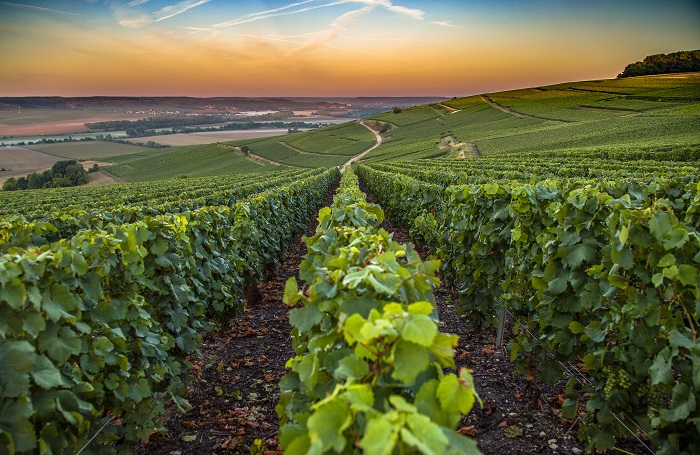
Seven people work full-time on this nine-hectare property, which only houses great wines. The vines flourish on the clay-limestone terroir of Le Mesnil-sur-Oger, which is characterised by shallow soils: 25 cm of topsoil resting directly on chalk tiles. All these elements give a formidable minerality to the wines. In addition to offering this famous acidity, limestone effectively plays a sponge role, providing water to the roots, even in times of drought. Water stress is therefore not feared.
Low-intervention vinification for terroir wines
After careful cultivation, the grapes are harvested by hand, at very good maturity (between 11 and 12°): the riper a grape is, the greater the number of yeasts contained on its skin. Pierre Amillet is therefore always one of the last in the village to harvest.
Once in the cellar, the bunches are pressed directly and then a static settling of about twelve hours. The juice is then put into barrels in which alcoholic fermentation naturally begins after three or four days, and for about three weeks. The monitoring is meticulous: densities and temperatures are monitored daily. Pierre Amillet does not intervene, it is a real terroir wine that is created in secret. Ageing on lees is spread over ten months, from September to July. Ten months during which malolactic fermentation is triggered, which can, sometimes, stop in winter and resume in spring. This stage takes place in barrels of three or four wines acquired from Burgundy winegrowers (Meursault, Chassagne-Montrachet).
In order to preserve the freshness and natural acidity of the wines, the work is usually done by gravity. Thus, the one and only racking is done when the wines are put in vats in July. Once bottled, the wine matures on slats for at least three years for the Les Grands Blancs cuvée and at least five years for the localities. The wine rounds out and "settles down" serenely. Riddling and disgorging ensued but, since 2020, the estate no longer doses its wines because they are considered sufficiently ripe and blossoming and no longer adds sulphite either.
Champagnes with (very) great ageing potential.
"My wines are wines for laying down that can rest for more than 50 years in the cellar. The oldest ones date from 1928 and are simply stunning! They have an incredible freshness that makes us forget the year. We recently tasted a 1973 and one of us was betting on a 2010... Thank you terroir! »
It's a fact, Pierre Amillet is passionate about wine. His "thing" is Chardonnay. From this noble grape variety, he signs wines that he is able to recognize among all those produced in the area, wines that balance maturity and freshness. In Le Mesnil, he makes the cuvée Les Grands Blancs, a blend of Chardonnays from about twenty plots out of the thirty-three he has. The Les Chétillons cuvée is a vine from Le Mesnil-sur-Oger vinified separately. Exposed to the south-east and populated by an outcropping chalk, it produces wines of great freshness, particularly taut and made for ageing. Less than two kilometres away, in Oger, is Les Vozémieux, another separate vinified plot which is differentiated by its orientation to the north and its clay soil resting on a chalk base. Wines that are born of it are often more open in their youth.
His passion for wine has even led Pierre Amillet to analyse the soils of a clay plot in Le Mesnil, to uproot a beautiful white vine to plant Pinot Noir in order to create a Coteaux-Champenois
This winemaker never rests on his laurels but gleans advice from Burgundy winemakers to understand and try, to "extract the best from the terroir". By dint of experimentation and tastings, Pierre Amillet can boast of signing very beautiful wines as well as vintage vintages every year.
